
Night Mail — The focus on work
Konrad Wakolbinger — 19.06.2023
"Night Mail" (1936) was commissioned as an image publicity film by the British General Post Office and went down in film history as a ground-breaking documentary. Directors Harry Watt and Basil Wright succeed in creating an ode to workers and modern technology by enriching their naturalistic style within the film with poetic elements and always keeping the human aspect in mind.
The Postal Special used to run daily from London to Aberdeen via Glasgow and Edinburgh. Half a million letters were sorted and distributed by 40 postal workers on board during the nightly journey. Using the example of one journey of this rolling post office, directors Watt and Wright documented the organisational and technical sophistication, as well as the performance of the postal and railway workers. “Night Mail” was intended to impress the public and thus repair the damaged reputation of the Royal Mail.
Traffic controllers, signal box operators, track workers, loading of mail bags, coupling of wagons, shot-by-shot, the directors build the picture of complex logistics that run like proverbial clockwork. Speed, timing, the interaction of technology and people are the supporting elements of this choreography of efficiency. The most modern technology of the time was also used for the filming, as in the impressive flight shots, one of which with the shadow of the plane in the picture. By locating the train in the landscape and involving the people along the track the film avoids portraying the Postal Special as a self-sufficient machine. As Auden’s poem in the final section of “Night Train” makes it clear, this train transports letters for all, in all circumstances.
Finally, it seems it was important to the filmmakers to show the workers not only as staff members, but also in their interpersonal relationships with each other as colleagues, killing time joking with the waitresses in the station café, or when they bicker and banter. It is precisely these dialogues that make “Night Train” so lively and give the documentary feature-film qualities.
As significant as the show-value of the railway technology is, “Night Mail” shows us that only the skills and knowledge of an experienced and well-rehearsed team make the “Travelling Post Office” functional. This can be seen through the precise sorting of letters without postcodes, and in the handing over of mailbags “on the fly”, a method of “loading and unloading” the mail at breakneck speed.
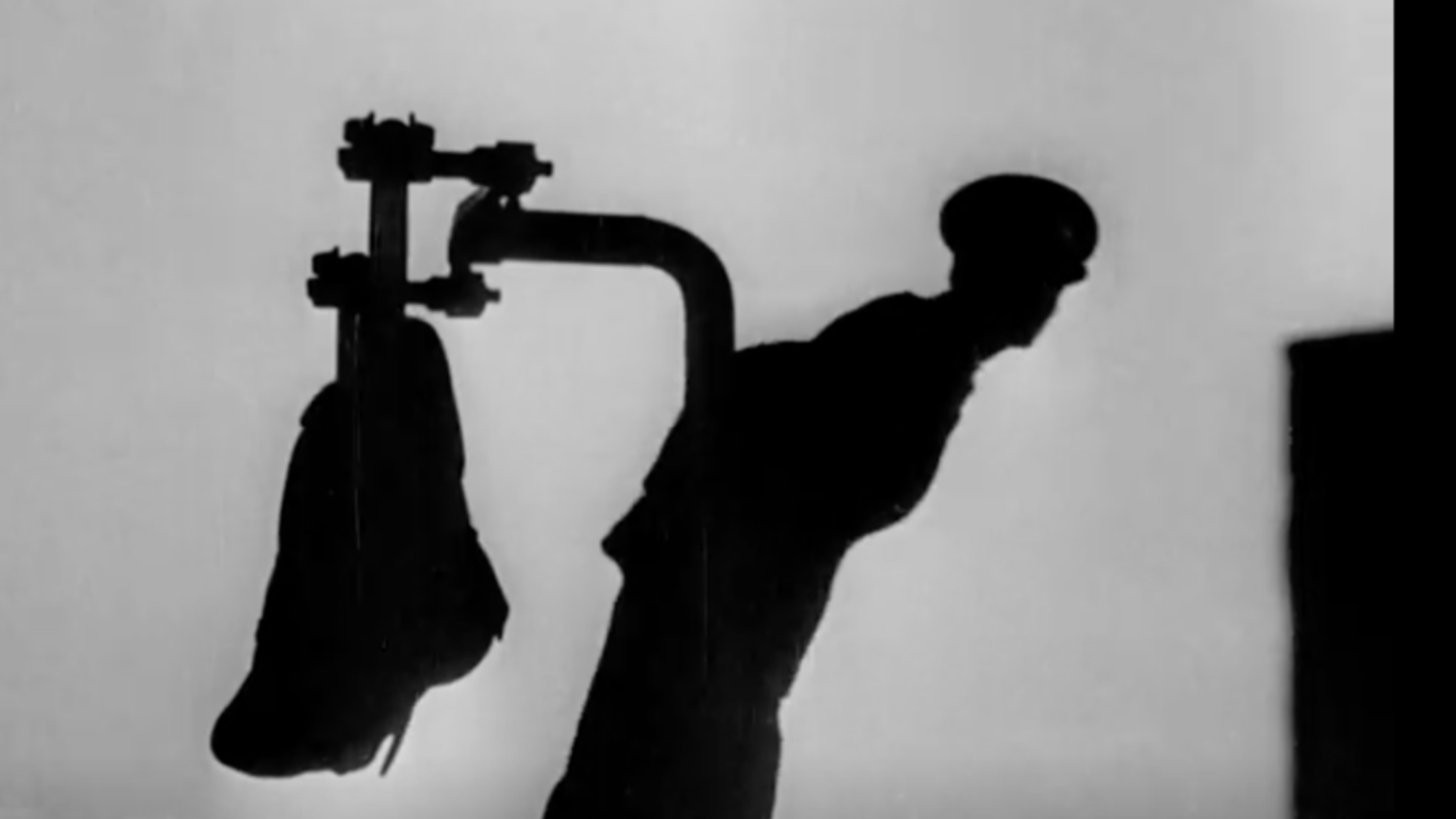
Through the artifice of training a new employee, the viewer learns how mail pouches are loaded and unloaded at full speed. By means of a device on the railway track with a transfer rack and a catch net and a corresponding device on the wagon, the speeding train throws off the pouch of outbound mail to be delivered and the pouch of inbound mail to be sorted slams into the wagon with great force. Until 1971, this “non-stop exchange” was practised in Great Britain and was also common in other countries, such as the USA. Experience and full attention were literally essential for survival in this job, because injuries, even fatal ones, were a constant danger.
Charles Hutchcraft from Illinois describes his experience on a US mail train: (Source: Oral Histories The Railway Mail System, National Postal Museum Smithsonian)
“On the train, the RPO, why, they call what they, they call a catch and throw, you call that, you catch a pouch of mail on the fly when you’re 80 miles an hour, you know, and then you put your hook out the window. Now that was something that was always exciting to me, I’ll never forget the first one, because that’s when we couldn’t even get insurance. If they knew you had a job like that nobody would insure you so you could get hurt awfully easy, so we’d start our own insurance, it still stands to this day.”
As dangerous and exhausting as work in the postal service could be, in 1936, when Night Mail was filmed, workers were still at the centre of the production process. As automation increased, workers became more and more inept, replaced by technical solutions and sometimes downright degraded to superfluous — “deplorables” (1) in Hillary Clinton’s diction.
There is a separate article on the poetic final part of the film, for which W.H. Auden and Benjamin Britten are responsible. Night Mail — The Poetic Gaze
1) Hillary Clinton refers to a portion of Donald Trump’s supporters as a “basket of deplorables” in a speech during a fund-raising event in New York on 9 September 2016.
Night Mail (1936) : GPO Film Unit / Crown Film Unit : Free Download, Borrow, and Streaming : Internet Archive
Travelling Post Office Drop-Off Demonstration
Library of Congress collection: 1903 demonstration of catching a mail bag „on the fly“
Tags ━━━━━━━━━━━