
Dystopias of the working world
Jörg Markowitsch — 31.07.2023
After more than a century, Katharina Gruzei's reinterpretation of the very first film in film history, ‘Workers Leaving the Factory’, shows a grim picture of the world of work and gives food for thought: Has the situation of workers deteriorated so much and what kind of worklife are we even heading towards?
The film “Workers leaving the Lumière factories” by the Lumière brothers in 1895, which we have deliberately selected as the cover photo of work-o-witch.at, is generally regarded as the first film ever made and respectively shown. The first camera in the history of film was pointed at the gate of the factory of the co-inventors of cinematography in Lyon, where photographic plates were produced. In the film, which lasts barely a minute, we see workers, above all women workers, streaming out of the gate. Although stylistically influential for documentaries of that time and later, this short film, which has only one take, is nevertheless staged and thus also the first feature film.
The film has not only found many imitators, it has also been used again and again by later experimental filmmakers as their point of reference, indeed, exactly 100 years later, Harun Farocki, for example, collected variations of this topos and assembled them into an excellent 30min essay film (Arbeiter verlassen die Fabrik, DE, 1995). Over the past two decades in particular, a new generation of experimental filmmakers has used Lumière’s film as inspiration for their commentary on the state of labour in contemporary society. What most of these “remakes” have in common is a certain style, which Jennifer Peterson calls “conceptual realism,” characterized by single, long takes, a commitment to observation, and an absence of editorial contributions. Most of the films eschew dialogue altogether.
Ben Russell’s “Workers Leaving the Factory (Dubai)” (USA, 2008), for example, films migrant workers leaving an enormous mega-construction site in Dubai in a single take and with a still camera. Here, the workers definitely don’t have that cheerful after-work mood, echoing the original. In a similar vein, nothing is explained and the viewer is forced to project meaning onto the film. A meaning which is pretty obvious in this case: the film makes an indictment of labour migration, globalization, and capitalism.
It was pleasure to explain during my contribution to the conferenceImages at Work: Labour and the Moving Image" at King’s College London, that there also exists a kind of “workers leaving the factory”-tradition in Austria. As early as 1984, internationally renowned avant-garde filmmaker Peter Tscherkassky took the physical film material itself as the source of a new film. In “Motion Picture” he mounted fifty 16mm strips of unexposed film on the wall and projected a single frame from the Lumière film, creating a new three-minute film that more or less dissected the original into shades of darkness and light. It’s like trying to reveal the code of (the) film itself.
Overtly grandiose for fans of avant-garde film, but of little use to labour researchers, as in my opinion it says little to nothing about work. The same can be said about "In, Over & Out” by Sebastian Brameshuber from 2015. The filming location is not a factory gate, but the staff entrance of a renowned French art school. Brameshuber films the students coming out with twelve cameras simultaneously, all using a different, outdated format. The only thing I find interesting about it, as a labour researcher, is the fact that 120 years after Lumière, knowledge work seems to have finally taken the place of manual labour.
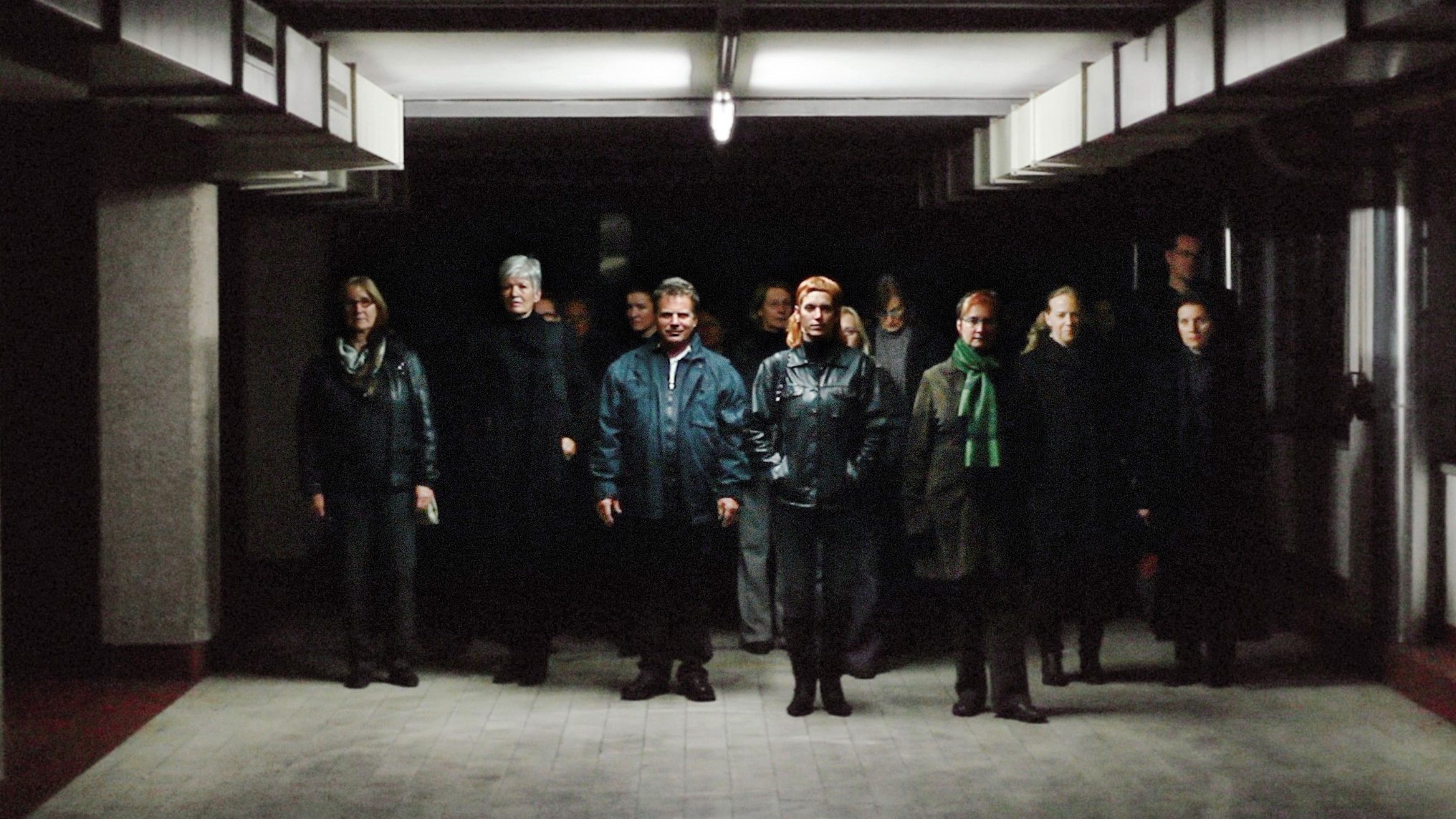
On the other hand, a film that I do find interesting, both from an artistic perspective and from the point of view of labour research, comes from the artist Katharina Gruzei*. With “Workers Leaving the Factory (again)” (AT, 2012), Gruzei, who lives and works between Vienna and Linz, has practically made a prequel thats is set in the present and yet could also be set in the future.
At first, the 10-minute film seems to have little to do with the original. The camera follows a group of dark figures from behind, walking down a sinister corridor in which neon lights turn on and off, unnervingly unrhythmically. The overall picture is gloomy, car park atmosphere, at night, in the basement, you don’t want to belong to this working class.
In stark contrast to the rather bright original, in which the workers dance beamingly out of the factory gate and the suspicion suggests that the female employees have even put on their Sunday best. Has the world of work really changed so much for the worse between 1895 and today? After all, 1895 also saw the birth of the Confédération Générale du Travail (CGT) and thus of the modern French trade union movement.
Gruzei’s remake sketches a dystopian picture of a working-class world in just a few minutes and thus raises fundamental questions about the present and future of work: What does work and labour mean today? To what extent has anything actually improved?
After a extended viewing, the parallels to the original do become apparent. For example, the light installation piece used in the film — also by Gruzei — creates a comparable flickering effect that is also inherent in the original. And at the very end, the original setting is recreated where the workers leave the factory. Yet, the factory gate is a rolling grille this time, and it is at night.
Notes:
*Der Vollständigkeit halber wäre auch „La sortie(AT 1998, 6min) by Siegfried A. Fruhauf could also to be mentioned and added to the list of “workers-remakes”.
„Motion Picture“ and other films by Peter Tscherkassky can be watched on MUBI .
Reference:
Peterson, Jennifer (2013). Workers Leaving the Factory: Witnessing Industry in the Digital Age In. The Oxford Handbook of Sound and Image in Digital Media, edited by Carol Vernallis, Amy Herzog, and John Richardson.
Arbeiterinnen verlassen die Fabrik, Katharina Gruzei, Ausschnitt
Katharina Gruzei spricht über Ihren Film „Die ArbeiterInnen verlassen die Fabrik“, 2min
Workers Leaving the Factory (Dubai), Ben Russell, USA, 2008, 6 min
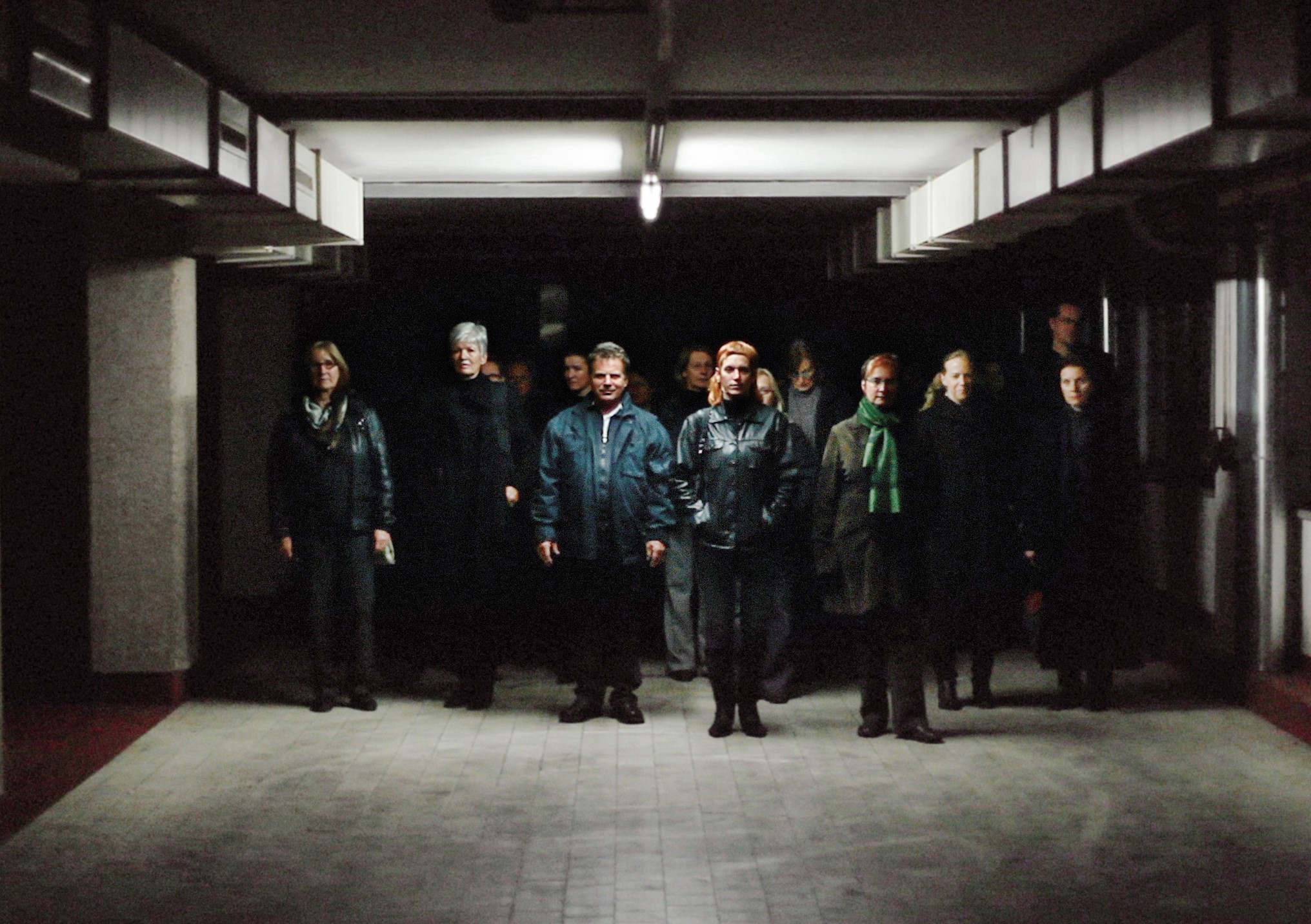
Katharina Gruzei, Die ArbeiterInnen verlassen die Fabrik Jahr, 2012, Österreich, Filmstill
© Sixpackfilm
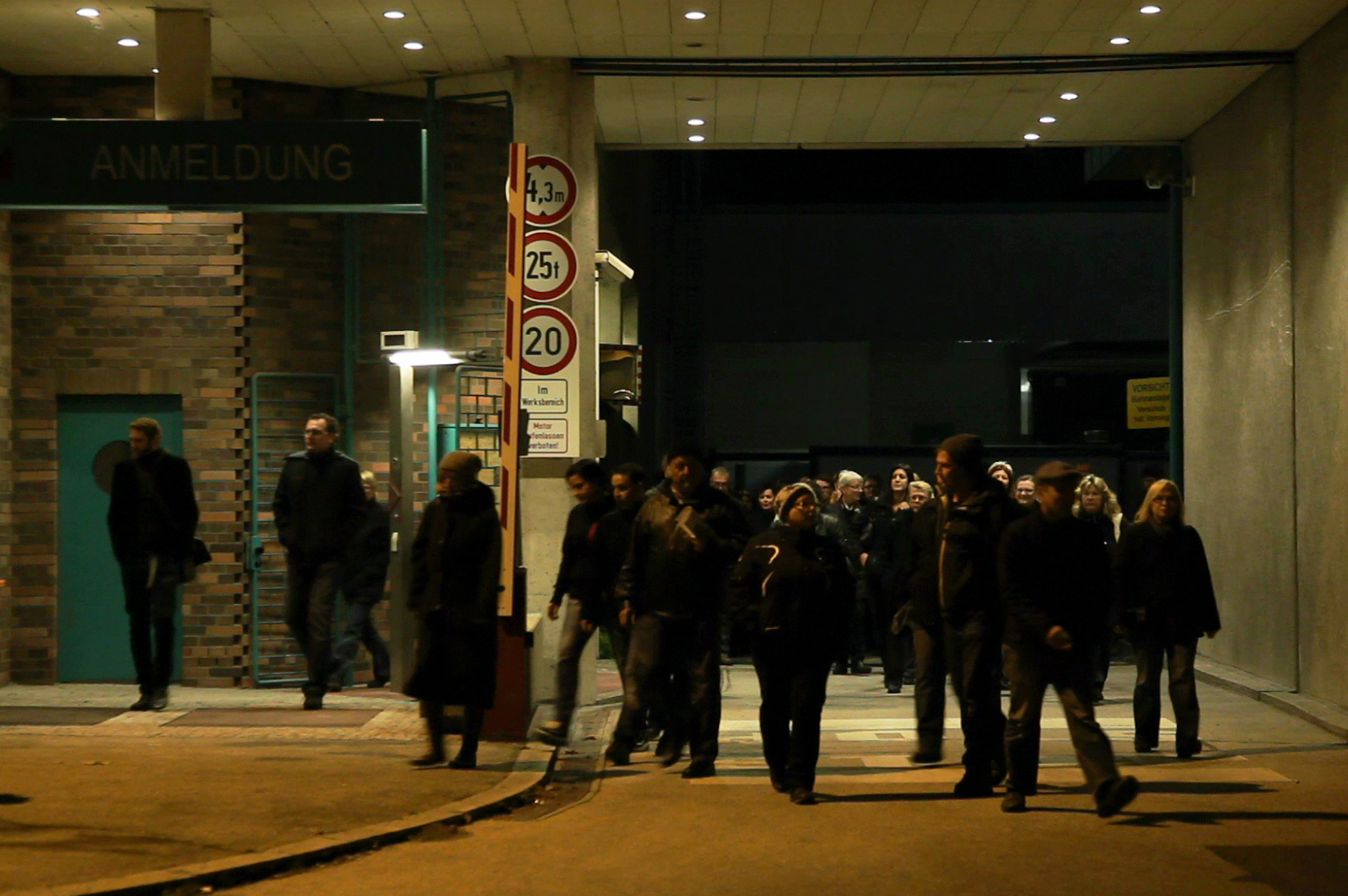
Katharina Gruzei, Die ArbeiterInnen verlassen die Fabrik Jahr, 2012, Österreich, Filmstill
© Sixpackfilm
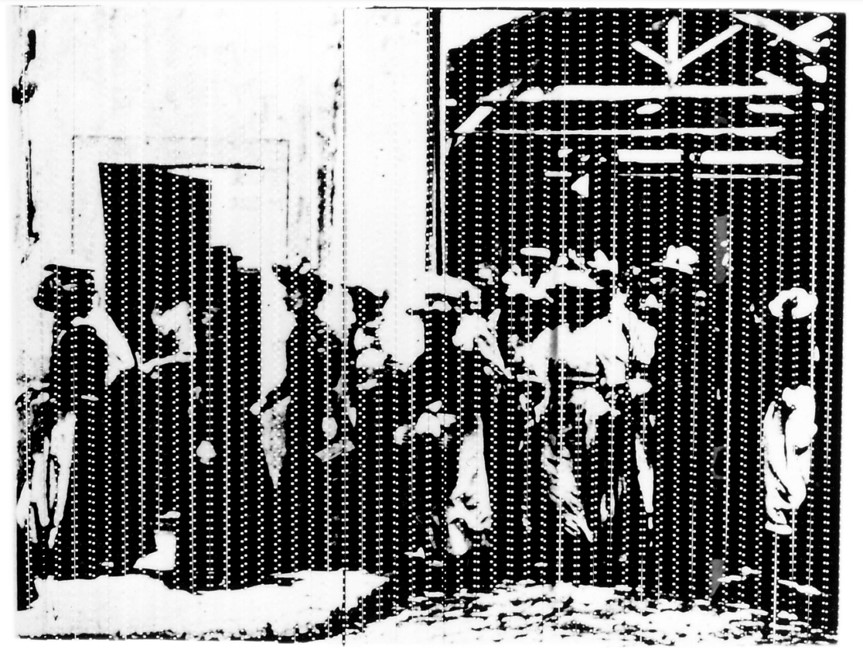
Motion Picture, Peter Tscherkassky, AT 1984, 3min.
© Peter Tscherkassky
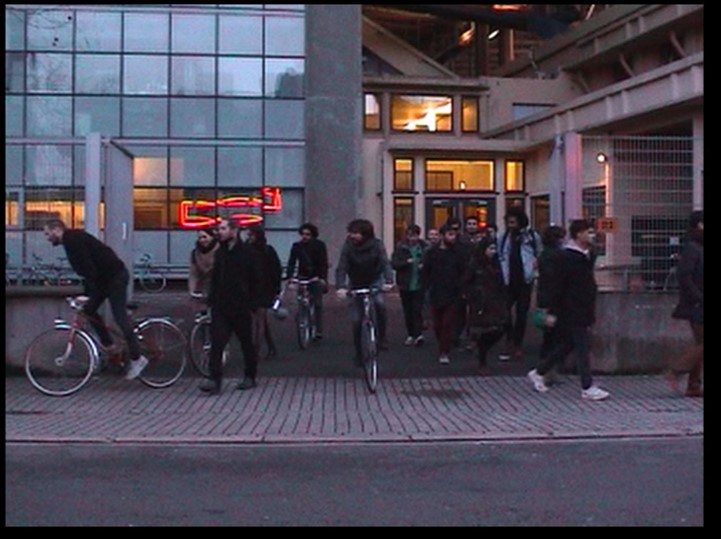
In, Over & Out, Sebastian Brameshuberm AT/FR 2015, 10 min.
© Sixpackfilm
Tags ━━━━━━━━━━━